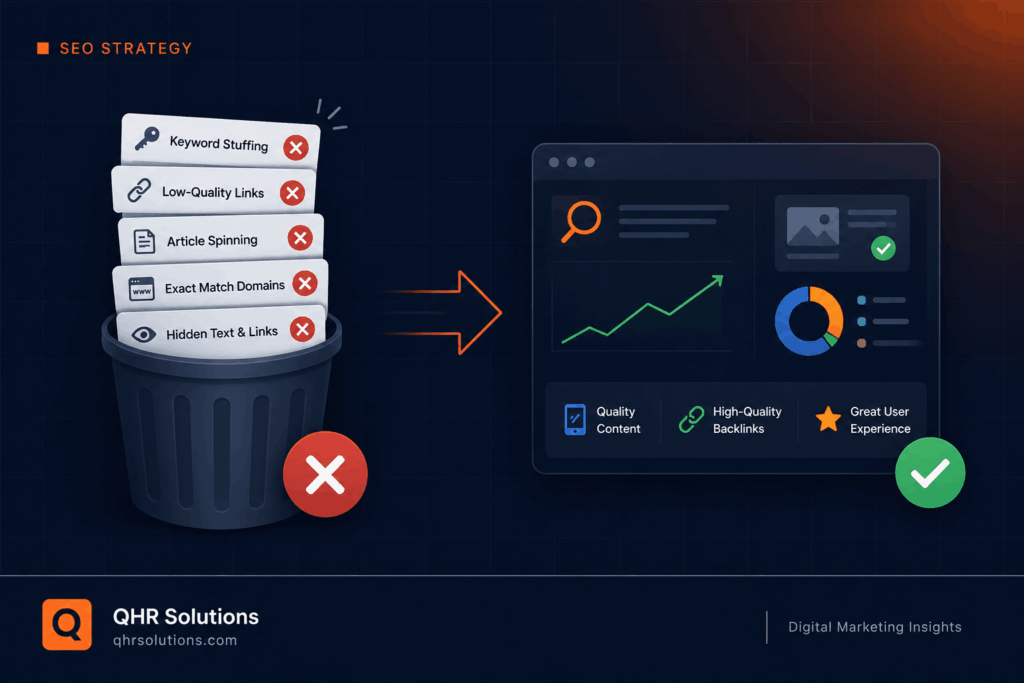
SEO practices that once seemed effective can become ineffective—or risky—when they prioritize manipulating search engines over helping people. In 2026, businesses should focus on a technically sound website, useful content, and clear measurement rather than shortcuts or ranking guarantees.
1. Keyword stuffing
Repeating the same phrase unnaturally makes content harder to read and can violate Google’s spam policies. Use the terms customers naturally use, include relevant variations where they fit, and answer the query completely.
2. Buying or manipulating backlinks
Large quantities of paid or irrelevant links do not equal authority. Earn mentions through useful resources, genuine partnerships, digital PR, and original expertise. Review Google’s link spam policy and use appropriate link attributes for paid placements.
3. Publishing thin pages for every keyword or city
Creating near-identical pages with only a city or keyword swapped adds little value. Build a page when it serves a distinct customer need and include genuinely useful local details, service information, and evidence. For businesses that rely on local discovery, keep your Google Business Profile accurate and consistent with your website. Consolidate overlapping content carefully; do not change URLs or redirect pages without a reason.
4. Publishing AI content without review
AI can assist with research and outlines, but it can also produce incorrect, repetitive, or generic material. Fact-check claims, add first-hand knowledge, cite reliable sources, and edit for your audience. AI use alone does not determine quality; the usefulness and purpose of the content matter. Use our E-E-A-T guide for more on demonstrating experience, expertise, authority, and trust.
5. Chasing keyword density
There is no universal keyword-density percentage that guarantees rankings. Use descriptive headings and natural language, then check whether the page satisfies search intent.
6. Treating meta keywords as a ranking tactic
Google does not use the meta keywords tag for web ranking. Spend time on meaningful page titles, helpful content, crawlability, and a good user experience instead.
7. Ignoring technical SEO
Important pages should be accessible to crawlers, return the correct status, use appropriate canonical tags, and link logically to related pages. Check indexing in Google Search Console and investigate performance with PageSpeed Insights.
8. Expecting schema markup to guarantee rich results or AI citations
Structured data can help search engines interpret supported content and may make a page eligible for particular features. It does not guarantee a rich result, ranking increase, or inclusion in an AI answer. Follow the official structured data guidelines.
9. Measuring success only by rankings
Rankings vary by query, location, device, and context. Monitor relevant impressions, clicks, qualified leads, sales, and conversion rate. Investigate performance changes before attributing them to a single update.
10. Neglecting real visitors
Make navigation clear, forms accessible, mobile layouts usable, and key information easy to find. A website should help visitors complete their task—not simply keep them on the page longer.
A sustainable SEO approach
Start by reviewing the pages that matter most to your business, fixing technical issues supported by evidence, and improving content where customers need clearer answers. For help with your website, explore our SEO services or contact QHR Solutions.